
Absolute Hobbyz
RC Car Setup Guide for Beginners: How to Dial In Your RC Car the Right Way
RC Car Setup Guide for Beginners: How to Dial In Your RC Car the Right Way Getting into RC cars is exciting, but it can also be overwhelming. You charge the battery, hit the throttle, and suddenly realize the car feels twitchy, unstable, or
Last updated 2026-02-02
RC Car Setup Guide for Beginners: How to Dial In Your RC Car the Right Way
Getting into RC cars is exciting, but it can also be overwhelming. You charge the battery, hit the throttle, and suddenly realize the car feels twitchy, unstable, or harder to control than you expected. Many beginners assume this means they need faster motors or upgraded parts, but in reality, most handling issues come down to setup.
RC car setup is about adjusting what you already have so the car handles predictably, stays planted, and feels confident to drive. A properly set up RC car is easier to control, more forgiving, and less likely to break parts during normal use. The good news is that setup is a learnable skill, and you don’t need advanced tools or racing experience to get started.
This guide walks through RC car setup basics for beginners, focusing on suspension, alignment, electronics, weight balance, and terrain considerations. The goal is not race tuning or copying professional setups, but building a solid baseline that helps you enjoy your RC car, improve consistency, and grow as a driver.
What “RC Car Setup” Actually Means
RC car setup refers to how your car is adjusted mechanically and electronically to influence how it behaves on the track or terrain. Instead of replacing parts, setup focuses on fine-tuning existing components so the car responds predictably to your inputs.
There are two primary sides to RC car setup. Mechanical setup includes suspension, ride height, alignment, and weight balance. These elements determine how the car handles bumps, corners, acceleration, and braking. Electronic setup includes steering trim, throttle calibration, and ESC configuration, which control how the car responds to driver input.
For beginners, setup is critical because it affects control and durability more than outright speed. A well-set-up car tracks straighter, corners more consistently, and recovers better from mistakes. It also reduces strain on servos, suspension components, and drivetrain parts, which helps prevent unnecessary breakage.
Start With a Baseline Setup
Before making adjustments, it’s important to establish a baseline setup. A baseline is a known, neutral configuration that you can always return to if changes don’t work as expected. Most RC manufacturers provide default settings that are designed to perform well across a wide range of conditions.
Starting from a baseline prevents one of the most common beginner mistakes: changing too many things at once. When multiple adjustments are made simultaneously, it becomes difficult to identify which change improved or worsened handling. Beginners should adjust one setting at a time and test the car between changes.
Keeping simple notes can be extremely helpful. You don’t need a formal setup sheet. Writing down what you changed and how the car felt builds understanding and makes troubleshooting much easier later.
RC Suspension Setup Basics
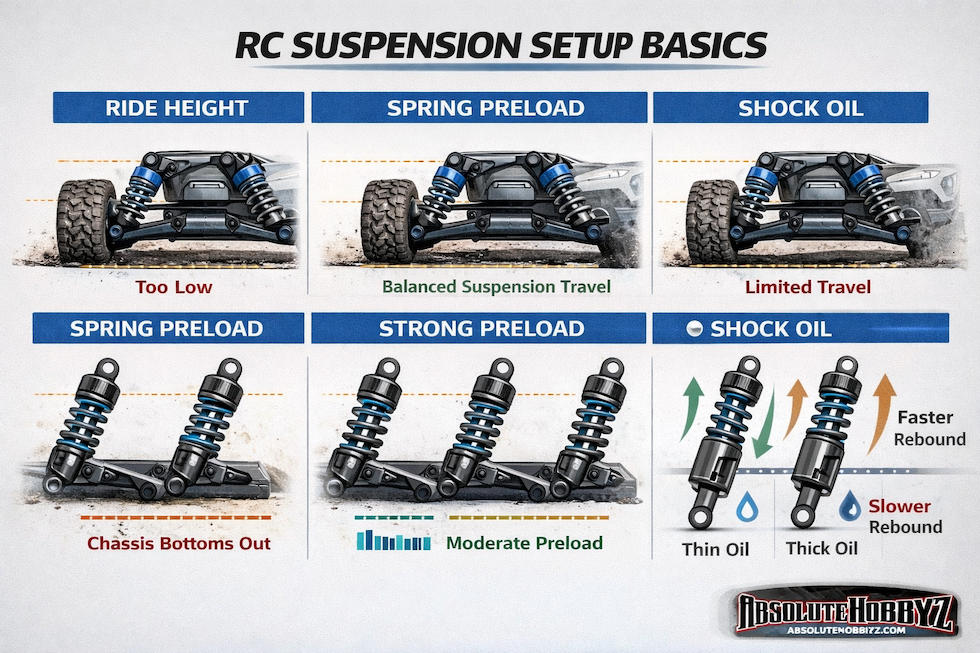
Suspension is the single most important area of RC car setup for beginners. Learning RC suspension setup basics helps improve traction, stability, and forgiveness, especially on uneven surfaces. Even small suspension adjustments can dramatically change how the car feels.
Ride Height
Ride height is the distance between the chassis and the ground. It determines how much suspension travel is available and how the car reacts to bumps, jumps, and cornering forces.
If the ride height is too low, the chassis may bottom out, causing loss of control and unpredictable handling. If it’s too high, the car can feel unstable and prone to traction rolling. Beginners should aim for a moderate ride height that allows the suspension to compress without slamming the chassis into the ground.
Ride height should always be adjusted evenly from left to right to maintain balance. Measurements should be taken with the battery installed, as battery weight affects suspension compression. Most adjustments are made using preload collars or spacers on common RC suspension parts.
Spring Preload
Spring preload refers to how much the suspension spring is compressed when the car is at rest. Preload does not change spring stiffness. Instead, it affects how quickly the suspension reacts to weight transfer during acceleration, braking, and cornering.
Adding preload raises ride height and makes the suspension feel more responsive initially. Reducing preload lowers the car and allows the suspension to move more freely. Beginners should treat preload as a fine-tuning adjustment rather than a primary tuning tool.
Small preload changes affect how various RC suspension components work together. Extreme preload settings should be avoided, as they limit suspension travel and reduce available grip.
Shock Oil (High-Level Overview)
Shock oil controls the speed at which the suspension moves. Thicker oil slows suspension movement, while thinner oil allows it to move more quickly. This affects how the car absorbs bumps, lands jumps, and responds to rapid steering inputs.
Beginners should generally stay close to the stock shock oil provided by the manufacturer. This guide to the best shock oil for RC cars explains how oil viscosity influences handling without diving too deeply into race-level tuning.
If the suspension feels bouncy or uncontrolled, the oil may be too light. If it feels harsh or unresponsive, the oil may be too thick. Shock oil changes become far more effective once the fundamentals of RC suspension tuning are understood.
Wheel Alignment Basics (Camber and Toe)
Wheel alignment plays a major role in straight-line tracking, steering response, and tire wear. The two primary alignment settings are camber and toe.
Camber describes the inward or outward tilt of the wheels when viewed from the front or rear. Slight negative camber helps maintain tire contact during cornering. Too much camber, however, can reduce straight-line stability.
Toe refers to whether the wheels point inward or outward when viewed from above. Toe-in generally improves straight-line stability, while toe-out makes steering more aggressive. Improper alignment is a common cause of common RC handling problems, particularly for beginners.
Electronics Setup for Beginners
Electronic setup ensures your RC car responds correctly to driver input and protects sensitive components. Many modern systems include adjustable settings that are often overlooked by beginners.
Steering Trim and Endpoints
Steering trim is used to center the wheels when the transmitter is at neutral. Proper trim allows the car to drive straight without constant correction.
Steering endpoints limit how far the wheels can turn. Correct endpoint adjustment prevents the servo from pushing against mechanical stops, reducing heat buildup and premature failure.
Throttle Calibration and ESC Basics
Throttle calibration teaches the ESC what neutral, brake, and full throttle positions are. Proper calibration results in smoother acceleration and more predictable braking.
For beginners, smooth control is more important than speed. Aggressive setups using high-powered RC motors can exaggerate poor setup and make the car harder to drive.
Battery Placement and Weight Balance
Battery placement significantly affects how weight is distributed across the chassis. A well-balanced car feels stable and predictable, while poor balance can cause excessive understeer or oversteer.
Moving the battery forward increases steering response, while rearward placement improves traction under acceleration. Beginners should focus on balance and consistency when working with RC batteries.
Terrain-Based Setup Tips
Different surfaces place different demands on RC car setup. Off-road terrain generally requires more suspension travel and ride height, while on-road surfaces benefit from lower ride height and firmer suspension settings.
Loose dirt surfaces often require softer suspension to maintain traction, while pavement rewards stability and precise control. Beginners should avoid constant re-tuning and instead aim for a balanced setup that works across multiple surfaces.
Common Beginner RC Setup Mistakes
One of the most common mistakes beginners make is changing setup settings without checking basic maintenance first. Following a regular RC car maintenance checklist ensures worn or damaged parts are not causing handling issues.
Many problems that feel like setup issues are already covered in a detailed RC car troubleshooting guide and do not require immediate tuning changes.
Other common mistakes include changing too many things at once, overtightening suspension components, and prioritizing speed over control.
Frequently Asked Questions
How often should I adjust my RC car setup? Only when something feels consistently wrong or when driving conditions change significantly.
What is the first setup change beginners should make? Ride height and steering trim are usually the best starting points.
Do I need different setups for bashing and racing? Eventually yes, but beginners can start with a balanced setup for both.
Can setup changes damage my RC car? Extreme mechanical or electronic adjustments can cause unnecessary wear or damage.
Is suspension more important than motor upgrades? For beginners, suspension setup usually provides more benefit than additional power.
Conclusion
RC car setup is one of the most valuable skills a beginner can learn. A properly set up car feels more predictable, more durable, and far more enjoyable to drive.
By starting with a baseline, focusing on suspension fundamentals, and making small, intentional adjustments, beginners can dramatically improve performance without buying new parts. Setup knowledge grows over time and makes every future upgrade smarter and more effective.