
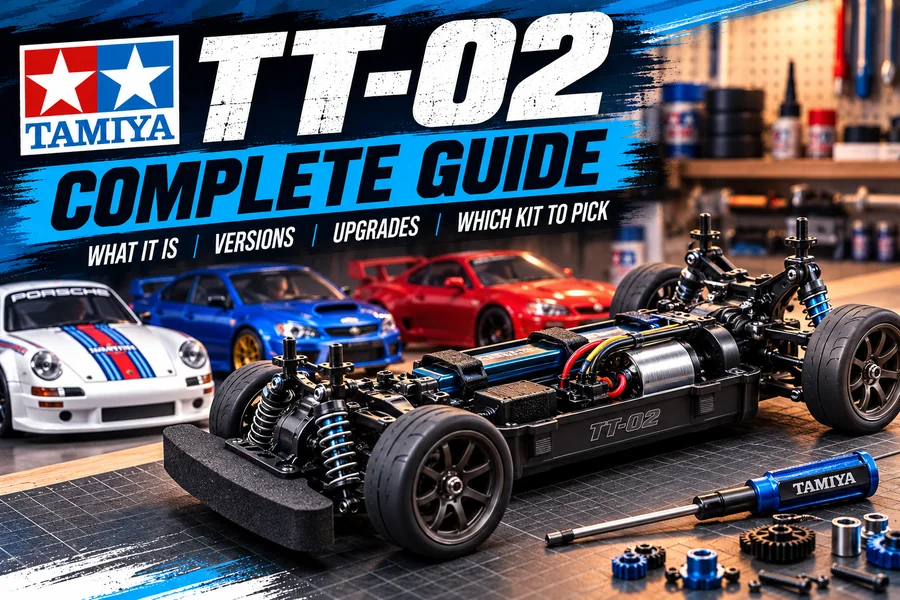
If you have spent any time looking at Tamiya touring cars, you have seen the letters TT-02 attached to what feels like half the catalog. A Porsche, a Lamborghini, a Supra, a Celica — different bodies, different boxes, same three characters in the name. That is because the TT-02 is not a car. It is the chassis underneath dozens of cars, and once you understand it, the whole Tamiya on-road lineup gets a lot easier to shop.
This guide covers what the TT-02 chassis actually is, how it differs from the TT-01 that came before it, what the various versions mean, which kit to pick, and the upgrades worth doing first once it is built.
What Is the Tamiya TT-02 Chassis?
The TT-02 is Tamiya's mainstream 1/10 scale shaft-driven 4WD touring car platform. Every wheel is driven through a central driveshaft running front to back, with gear differentials at both ends. It is a kit, not a ready-to-run car, so you build it yourself from the box — which is a large part of the appeal, and the reason Tamiya kits get recommended to people who want the hobby to include some time at the workbench.
Three things explain why it has become the default starting point for on-road RC:
It is designed to be built once and understood quickly. The tub chassis goes together with screws rather than glue or specialist tools, the instructions are famously clear, and nothing about the layout is hidden or hard to reach when you need to service it.
It is adjustable in the ways that matter. The TT-02 offers two wheelbase lengths, two ground clearance settings, two track width set-ups, and ten possible gear ratios — all from the standard kit, with no option parts required. That last number is the one to pay attention to: changing the pinion and spur gear combination lets you set the car up for a tight parking lot or a long straight without buying a different car. If gear ratios are new to you, our RC gearing guide explains how the numbers translate into speed and acceleration. The two wheelbase settings are also why you will see some TT-02 kits listed at 251mm and others at 257mm — same chassis, different configuration for the body it carries.
The layout itself is deliberately simple: the driveshaft runs the length of the car with the battery on the left and the motor on the right for balance, the left and right suspension arms and uprights are identical parts, and the gearboxes are built to be opened and serviced rather than wrestled with. Standard kits run plastic bushings and friction dampers, with ball bearings and oil-filled shocks as the obvious upgrades — more on those below.
Parts support is enormous. Because the same chassis sits under so many kits, spares and option parts are easy to find and stay in production for years. That matters more than it sounds like it should. A chassis with plentiful parts is a chassis you keep running instead of shelving.
Tamiya TT-02 vs TT-01: What Actually Changed
The TT-01 was the previous generation of the same idea, and you will still see used ones for sale. The TT-02 replaced it with a redesigned chassis that is easier to build, easier to work on, and considerably more adjustable.
The practical differences come down to three things. First, maintenance: the TT-02's layout puts the parts you service most within easy reach, where the TT-01 often meant disassembling more to get to less. Second, tuning: the TT-02's motor mount and suspension mounting offer more adjustment out of the box, which is why it is the platform club racers build on. Third, and most important if you are buying today, parts availability: the TT-02 is the current platform, so new kits, spares, and option parts are all built around it. TT-01 parts do not all carry over.
If you are choosing between a used TT-01 and a new TT-02 kit, the TT-02 is the easier ownership experience by a wide margin.
Tamiya TT-02 Versions Explained
This is where most of the confusion starts. "TT-02" refers to the family, and there are several variations within it. Here is what each one means.
| Version | What Makes It Different | Who It Suits |
|---|---|---|
| TT-02 (standard) | The baseline kit. Plastic bushings and friction dampers as standard, with ball bearings and oil-filled dampers available as upgrades. | First-time builders and anyone who wants to start simple and upgrade over time. |
| TT-02 Type S | The tuning-oriented version, with adjustable suspension geometry and a wider track for sharper on-road handling. | Builders who already know they want to set the car up rather than just run it. |
| TT-02 Type SR and SRX | Race-leaning kits built on the Type S idea, with additional performance parts included from the box. | Club racers who would otherwise buy those upgrades separately. |
| TT-02R | A racing-spec chassis kit that bundles a package of option parts rather than a specific licensed body. | Anyone building a dedicated race car and choosing their own shell. |
| TT-02B | The off-road buggy version of the same shaft-driven platform, with buggy suspension and tires. | Drivers who want dirt and grass rather than asphalt. |
The important takeaway: the standard TT-02 is not a lesser car, it is an earlier stage of the same car. Nearly everything that makes a Type S or an R faster can be added to a standard TT-02 later, which is exactly how most people do it.
Which TT-02 Kit Should You Buy?
Here is the part that surprises people. Across the standard TT-02 kits, the chassis in the box is the same. What changes is the body shell, the wheels, and the decals. So the honest answer to "which TT-02 should I buy" is: pick the car you actually want to look at, because the driving experience will be near identical.
That makes it a genuinely fun decision rather than a technical one. The TT-02 kits currently in stock at AbsoluteHobbyz cover several very different moods:
Modern GT racers. The Porsche 911 GT3 R (992) and the Mercedes-AMG GT3 EVO are current-era GT3 machinery, wide-bodied and aggressive, and they look the part on smooth asphalt.

Japanese touring car icons. The AU TOM'S GR Supra recreates the Super GT500 machine, complete with race team livery stickers, canards, and a large rear wing. The Celica GT-Four comes in two flavors: the Celica GT-Four ST205, and a Celica GT-Four that ships with the body already painted in black with smoke windows and the wheel arches pre-cut — a genuine shortcut if you would rather drive this weekend than paint.

One detail worth knowing before you pick: some of these kits arrive with a brushed motor and electronic speed control already in the box, and others expect you to supply them. Check the "needed to complete" list on the product page before you order, so you are not waiting on a part.
One note on scale, since Tamiya kits are often someone's first: all of these are 1/10 scale, which is the most common size for on-road RC and the easiest to find parts and bodies for. Our guide to RC car scales and sizes covers how the scales compare if you are still deciding.
The Best TT-02 Upgrades, in the Order to Do Them
The TT-02 is built to be improved gradually, and the order matters more than the total spend. These are the upgrades that change how the car drives, roughly in the sequence most people find useful.
1. Ball bearings. Standard TT-02 kits run plastic bushings rather than bearings — the spec sheets say so plainly. Swapping in a full set of ball bearings reduces friction throughout the drivetrain, which means more speed and longer runtimes from the same battery. It is the single best value upgrade on the platform and worth doing before anything else.
2. Oil-filled dampers. Friction dampers work, but oil-filled shocks control how the car settles after a bump or a direction change instead of letting it bounce. This is the upgrade you feel most in corners.
3. Gearing and motor. Because the TT-02's motor mount takes different pinion sizes, you can change the car's character cheaply before you ever buy a new motor. Once you are ready for more power, a brushless motor and matched speed control is the step up — just work out your gearing at the same time rather than after.
4. Tires. On a touring car, tires decide how much of the power reaches the ground. The right compound for your surface makes a larger difference than most people expect, and our guide to choosing RC tires breaks down what to run where.
5. A high-torque servo. Once the car is faster and gripping harder, the stock steering servo becomes the weak link. A stronger servo makes the steering feel immediate rather than vague.
6. Metal and hardware upgrades. Aluminium motor mounts, propeller joints, and a stainless steel screw kit add durability rather than outright speed. Worth doing once the car is seeing regular use, and the screw kit is best fitted during the build, before the stock screws have a chance to rust or strip.
Once the car is upgraded, dialing it in is its own skill. Our RC car setup guide covers the adjustments that turn a fast car into a fast car you can actually drive.
What Else You Need to Run a TT-02
A TT-02 kit is a chassis and a body, not a complete package. Budget for these alongside it:
A radio and steering servo. A 2.4GHz transmitter and receiver set, plus a servo for the steering. Any modern entry-level surface radio will do the job.
A motor and speed control, if your kit does not include them. Several TT-02 kits ship with a 540-size brushed motor and a HobbyWing THW 1060 speed control already included, which makes them close to a complete package. Others list both as sold separately. This is the one line item that varies between kits, so check before ordering.
A battery and charger. Buy these together so you know they are compatible, and store your packs safely.
Paint and tools. The body shell arrives clear and unpainted, so you will want polycarbonate-safe spray paint. A basic set of hobby tools — good side cutters, a hobby knife, and proper hex drivers — makes the build faster and cleaner, and pays for itself across every kit you build afterward.
Frequently Asked Questions About the TT-02
Is the TT-02 a good first kit? It is one of the best, particularly if you want an on-road car. The build is straightforward, the instructions are excellent, and nothing about it punishes a first attempt. If you would rather go off-road for your first build, our guide to the best Tamiya kits for beginners covers the buggies as well, and our Grasshopper vs Hornet comparison goes deeper on the two classic starting points.
Can you race a TT-02? Yes. Many clubs run TT-02 classes precisely because the chassis is affordable and widely owned, which keeps the racing about driving rather than budget. A standard TT-02 with bearings, oil dampers, and decent tires is competitive in that company.
How long does a TT-02 build take? Most builders finish in a few sessions across a weekend, taking it slowly. There is no reason to rush it — the build is part of what you are buying.
Do TT-02 option parts fit every TT-02 kit? Parts made for the TT-02 chassis fit across the standard kits, since the chassis is shared. Parts specific to the Type S and its derivatives are the exception, as those versions use different suspension components.
Is the TT-02 4WD? Yes — shaft-driven 4WD, with a driveshaft running the length of the chassis and gear differentials front and rear.
Start Your TT-02 Build
The TT-02 earns its place as Tamiya's default on-road platform by being easy to build, cheap to run, deep enough to race, and simple to upgrade one step at a time. Pick the body you want on your shelf, because the chassis underneath is the same car either way.
Browse the full Tamiya RC car kit lineup to see every TT-02 and Tamiya kit currently in stock.
